Kittie Howard


Saturday, July 20, 2013

Welcome to Lido di Jesolo, Italy


Time stopped in Lido de Jesolo! Our clock became the moon over the Adriatic Sea. Three evenings ago, my husband said, "The moon's a little bigger tonight." We both knew a day had passed, but neither asked the other which day. Now we're both aware we're leaving a week from Sunday. Now, when we say good-bye to other tourists after breakfast, we know our day grows closer. Even though we're going on to France from here, we're going to be sad about leaving Jesolo. We always are. We haven't found another holiday spot situated between the beach/pool and a tree-lined town that's completely pedestrian in the evening. Shaded sun for hub and walks in the shade during the day for me. I'd like to share some photos from my morning's walk.

The Ambasciatori Palace hotel provides free bikes, for the whole day if one desires, a good thing. The bikes are retro, just brakes, no gears. Since the land is flat, everyone just peddles along. It's nice, very nice. In the evening, the main street above will be pedestrian only. People will fill the street, just walking and talking and eating ice cream . . . or stopping for a coffee or glass of wine or bottle of cold water at one of the many coffee bars or eateries.

One of the menus. The price is in euros. One euro is about $1.30. The price you see includes tax and tip.
Something for everyone - water, Prosecco, wine

Display in one of the clothing shops. Marilyn Monroe remains eternal.

One of the many pizzerias/restaurants. The crust is very thin, with just enough sauce to cover, fresh toppings you order, and a little cheese. Unlike Pizza Hut, which uses melted lard to first coat the crust, they only use extra virgin olive oil here. Apartments are above the restaurant.

The United States is a Fair Trade Partner . . .


. . . so our products are popularly sold here . . .

. . . but like everywhere else, cheap Chinese goods are a problem. These are 2 euro copies of  hand-blown Murano glass pendants that would sell for between 10 and 20 euros. Collected together, these don't look half-bad. But they don't catch the light and look really cheap when worn. On Murano, the island near Venice famous for its glass factories, the pendants are displayed hanging in windows so one can see how the light infuses the pendant. They're absolutely gorgeous. So that's why the copies are in boxes . . . and clipped to the box at the back so it's too complicated for the tourist to hold up.

Like for authentic Murano glass, there are Made in Italy signs for leather goods.


Hub loves this 'salad of the sea' -- but see those black balls that look like olives? Umm, they're not olives; they're snails, a special type of snail. And they're alive. And they crawl around in the bowl. So, okay, one can't like everything everywhere, so, umm, I'm taking my usual pass here.

An Italian take on the British saying, "Keep Calm and Carry on." This is my favorite photo from our morning's walk. Thanks for coming with me. It was lots of fun. Until later, lots of hugs, K.

Thursday, June 27, 2013

Off to Italy; Blog on Mini Hiatus


Italy beckons -- the day that seemed a million years away is tomorrow -- wheee!

We'll fly to Vienna, Austria, spend the night at the NH Hotel (exit airport, cross street, go to room, crash), then catch an early a.m. flight to Venice (taxi to the Ambasciatori Palace hotel in Lido de Jesolo, go to room, change clothes, go to pool, start reading under shade tree, and zzzzzz and read and . . .).

Along the way, I hope to get caught up in Blogville and with my WIP as I've fallen woefully behind in this crazy month June's been.


Venice -- I liked how the bird perched on the post and enjoyed the breezes.

The nearby island of Burano and my favorite ferry stop. We go early, get a coffee at an outdoor place by one of the canals and watch the island come alive.

I walked around after our coffee to take some pics. A bicycle always pulls me closer. Burano is laid-back, not as commercialized as Venice. 
I can't resist these caloric bombs! Ohhhhh, pure bliss! Not too sweet with a hint of almond. *sighs*


The chocolate-creme torte hub surprised me with on my birthday last year! Very light, not too sweet *sighs again*


The beach/Adriatic Sea view from our room. We've had the same room the past six years. The shadows in the foreground are the trees by the pool. The heart shape in the sky is from an air show by Italy's air force. The horizon's grey cross the sea is Croatia. A few years ago we drove around the land hook and explored Croatia. Gorgeous scenery but few hotels and absolutely brutal prices for everything as their tourist market caters more to the enormous yachts that drop anchor.

Hub's favorite . . . no canned mushrooms and fake cheese . . .
. . . right around the corner . . .  on Sunday morning this area's more like Hangover Corner. Every Saturday night there's a huge beach party that draws kids from as far away as Milan -- very rich kids with incredibly expensive cars, parked wherever they can find a spot, convertible tops down (people admire but don't touch cars that are more like works of art) -- anyway, the party's loud (we bring ear plugs) and goes into the wee hours. Italians harness rather than fight rites of passage. When these kids learn to control their wild horses, they'll tolerate the same parties they're recovering from. And, counter image, Italy's got some really tough laws, as does all of the European Union, actually. No one even thinks of taking a sip of wine and driving, nononono!


Tiles by the pool . . . this is more our speed.
Happy Summer, Everyone!


Wednesday, June 12, 2013

Vanity Fair and Mary McCarthy's "The Group": Advice for Writers

Vanity Fair, Food & Wine, and Architectural Digest are my magazine treats, when I flop on the sofa and get lost in their pages. "Vassar Unzipped" by Laura Jacobs in the July issue of Vanity Fair, however, had an interesting point I thought would also catch your eye.

Jacobs does a great job of fleshing out backdrop stories surrounding Mary McCarthy's "The Group," her 1933 book about eight Vassar girls that was on The New York Times best seller list for almost three years. And, in the process, Mary McCarthy revolutionized much for female writers.

As Jacobs summarizes her article about McCarthy's career, she writes, "Novelists lift material from life because they must. First novels are invariably autobiographical, which is why second novels are so difficult: the writer needs to recede and let the characters create themselves. McCarthy never learned to back off and loosen her grip." (page 119)

Can you relate to what Jacobs wrote? I know I can. My first novella became more autobiographical than I thought it would. My second novella gave me fits until I instinctively realized I had to let a couple of characters do what they wanted to do. But, if I'd known to back off going into the second novella, I could've saved myself a lot of time and frustration.


Tuesday, April 16, 2013

A Little Box in Zanzibar

When the Kenyan Airways flight from Nairobi, Kenya, landed in Dar es Salam, the capital of Tanzania, I didn't know what to expect. Those few I knew who had visited Dar had described the city as 'sleepy' and then turned to talking about how they'd climbed Mount Kilimanjaro, Tanazania's famed mountain and exotic attraction in the late 1980s tourists knew about but hadn't yet conquered. Nor had tourists swarmed to the Serengeti for photo safaris. Roads leading outside Dar turned into unpaved challenges.

So this trip focused on Zanzibar, the coastal 'spice' island where so many of David Livingston's 19th century explorations had begun and ended.

As warned, Dar turned out to be sleepy. Buildings were mostly baroque and representative of the country's colonial past or cinder-block utilitarian and representative of the Soviet Union's influence. Unlike Nairobi, few cars traversed the downtown's paved streets, and even fewer people were on sidewalks. Those who did were solemn-faced. Shopkeepers waited behind window displays with scant merchandise. Like many countries in Africa during this period, Tanzania struggled to establish a foothold, both politically and economically.

With a sense of relief, we boarded the hydrofoil for Zanzibar, the only passengers on this sleek new vessel. Once we'd cleared the mainland, a young lady emerged from the pilot's cabin and joined us. She and her husband, the pilot, were from South Africa and had gambled their futures Zanzibar would turn into a tourist destination their hydrofoil could service.

As it turned out, they were right. Dar es Salaam now bustles with activity and shines from travel magazines. Zanzibar has an international airport, an international film festival, and tucked-away resorts high-end tourists seek. Whenever I see an advertisement for either, I sometimes wonder if that couple survived the lean, in-between years. I hope so.

In the meantime, the Indian Ocean's fresh air rejuvenated spirits, and we enjoyed the ride. After docking, we wished the young couple well and made our way to a quaint house not far from Stone Town, the former capital of the Zanzibar Sultanate, where we'd secured reservations before leaving Nairobi.

But, as it turned out again, we were the only guests. With scant running water in the un-airconditioned room, we patted water on our faces, set up the mosquito net, then shut the windows. We'd have to return from Stone Town before the mosquitoes found a way in through the loose frame (and, to our surprise, would swarm the white netting until it practically turned black).

As we neared Stone Town, our eyes widened. It was as though we walked into National Geographic, as close to a surreal experience I've ever experienced. Not only was it the visual experience of children playing in the town's dusty square near the historic Old Fort or vendors selling corn roasting on portable stoves or vegetables for sale or women gossiping beneath gnarled trees -- much of this existed elsewhere in Africa as well.

No, it was a combination of all of this and the Indian Ocean dotted with dhows -- and, more -- it was the scent of cloves. . . everywhere . . . on people's skin and clothes like the finest perfume . . . dancing on every ocean breeze . . . resting in narrow passageways . . . everywhere.

We bought ears of roasted corn and sat beneath one of the trees -- very happy we were the only tourists -- and munched our corn. A middle-aged woman approached us. In her hands she held a box that was about four inches by six inches.

She had made the box entirely of cloves. When I opened the lid, it was as though every holiday treat ever baked wrapped around my senses and brightened every smile ever smiled.

She wanted to sell me the box. When I asked how much, she replied, "One thousand dollars."

Two other women joined us, each with boxes. Some good-natured bargaining followed. The price changed to $100,000.

Ahem, that's a lot of money.

Convinced they'd met me half-way, the ladies were disappointed when I didn't buy one of their boxes.

I was, too.

But through the years, the memory of how a simple spice floated on breezes has made me think upon occasion . . . as it did after the massacre in New Town . . . as it did after the bomb explosions in Boston . . . for there was a time when a certain innocence prevailed . . . when a day began without tears for a loved one or friend or a stranger's heavy heavy heart didn't slow steps . . . and the thought of what-might-be wasn't held prisoner by what-had-been . . . so, as if reading my thoughts, my husband, a marathoner and tri-athlete who ran Boston some years ago, asked, "What if go to Boston next year to watch the Marathon?"

"Sure," I said. "I'm in."

And we returned to the television and the horrific events in Boston. . . it's all so sad, so very sad . . . but a sense of resolution and support propels one forward.


(Note: This in the second in a series of Things That Happened Along the Way.)


Approaching Zanzibar by air.  (Wikipedia)


Stone Town (Wikipedia)


Friday, April 5, 2013

A Taste of Greece

I love Greek food, and, to be happily honest, it loves me.

Three years ago, hub and I rode the ferry from Venice, Italy, to Patras, Greece, picked up our rental car and embarked upon one of our greatest trips ever: three weeks of exploring Greece, the birthplace of Western civilization . . .
Parthenon (Wikipedia)

 and the home of some of the most delicious food in the world. . .

including Dolmadakia Yialandji--also called Dolmades--Stuffed Grape Leaves--and one of my absolute favorites. You can stuff the grape leaves with just about anything, but, for me, the simpler, the better--just a few seasonings with the rice mixture--and there's sheer bliss! (theshiksa.com)
And, so, I'm sharing with you Martha's recipe (with her permission). Martha's a Greek-American lady I met some years ago at a Christmas function. One taste of her Dolmades and I knew Santa Claus was for real. Oh, yum! Her recipe is very simple, but it works. Instead of being overstuffed with too many competing flavors, these Dolmades are bursting with flavor. And, I didn't have to adjust the salt much (always a personal choice).

Surprisingly, Dolmades aren't difficult to make and easily feed a crowd. After Martha's recipe, there's a YouTube clip that shows how to roll the leaves and then gives a lemon sauce recipe for dipping, if desired. The chef in the video has a different recipe than Martha's for more ideas. You can be really creative. When we lived in Egypt, a neighbor added chopped garlic not only to the rice mixture but put a few cloves of garlic among the layers, along with a few slices of lemon. Other variations exist among the Mediterranean countries and elsewhere.


Martha's Grape Leaves Stuffed with Rice (Dolmadakia Yialandji)

4 medium onions, finely chopped
1 teaspoon salt
2/3 cup raw rice (short grain)
3/4 cup olive oil
l tablespoon fresh dill, chopped
l/2 cup parsley, chopped (reserve stalks)
3 bunches scallions, including green tops, chopped
1 small grated carrot (optional)
salt and pepper
juice of one lemon
12-ounce jar grapevine leaves (found in most specialty stores and larger supermarkets)
l cup boiling water

Prior to combining ingredients, soak and drain grapevine leaves several times to remove the brine; if you have fresh grapevine leaves, wash carefully.

Steam onions over very low heat with 1 teaspoon salt, stirring occasionally for 5-10 minutes. Remove from heat. Add rice and l/2 cup of olive oil and mix. Add herbs and mix. Add salt and pepper and half the lemon juice.

Separate grapevine leaves carefully. Snip stems. Place 1 tablespoon filling on underside of leaf. Starting at the base, fold over, and fold in sides, rolling tightly toward point. (Note: the video starts with the sides; I think Martha's way gives a tighter roll as these leaves do expand.)

Place reserve stalks and any torn leaves on bottom of pan. Arrange Dolmandakia in layers with seamed side down. Add the remaining lemon juice and  3/4 cup olive oil. Place a plate on top of dolmadakia to prevent them from unrolling.

Cover sauce pan and simmer for 20 minutes over low heat. Add l cup boiling water and simmer for 25 minutes longer. (Note: Video calls for baking leaves. Have never done this so don't know.)

Transfer to platter. Drizzle with olive oil and lemon juice, if desired.

The YouTube clip is HERE.

Enjoy!


Thursday, March 28, 2013

Easter in Thessaloniki, Greece


As Easter approaches, I'm entertaining nice thoughts about past holidays:  the smiles . . . a little something that stuck in the mind's eye -- a panoply of tulips near the front steps to my mother's house and when I opened the door the aroma of good things cooking in the kitchen flooded my senses. Yes, that's what happy memories do. They flood the senses and wrap the soul in warm fuzzies.

Such is the feeling now. Even though it's cold outside and spring's a no-show, I feel warmed and blessed by so much. So many good things. From the Hallmark angel my niece gave me to family trips and gatherings to an Easter in another country that was also very, very nice.

Thessaloniki, Greece.

In 2004, my husband and I spent Easter in Thessaloniki. It's a traveler's story for a lazy afternoon as to how this came to be, but, suffice it to say, we were delighted it did. Even if we aren't Greek Orthodox and even if Easter's dates float among the Christian faiths, it didn't matter. Oh, but life's roller coaster can take some magical turns. I'd like to share one of those turns. Come on. Don't be shy. Put on your virtual Nike's. We've got some hoofing to do before we get to what infused the senses . . .

With about a million residents, Thessaloniki sprawls from the Aegean Sea to the mountains. (Mount Olympus is in the background.) Alongside the sea is a corniche where one can walk and browse shops, stop at one of the many outdoor coffee shops or restaurants or get an ice cream cone and just walk and walk. (Wikipedia)

The port is huge, one of the largest in Europe.  (Wikipedia)

Our hotel was in Aristotelous Square (formerly known as Alexander the Great Square), in the hotel to the left. (Wikipedia) Prior to Easter, people packed the square, in a hurry to complete pre-Easter errands. Others fortified themselves with cups of coffee or something to eat in coffee houses and seafood restaurants on either side of the Square prior to entering the melee.

Not far from the Square were more coffee houses and restaurants along the corniche. In one direction, the corniche led to the White Tower . . . 
The White Tower is the city's signature landmark. It is one of 15 UNESCO World Heritage sites in Thessaloniki, also considered Greece's cultural center by many. Love that corniche! (Wikipedia)

A cup of coffee and an ice cream later and we circle back. This ruin (forum and baths) isn't far from the city center and was discovered by accident in the 1960s. Whether in Thessaloniki or elsewhere, it seems like everywhere one goes in Greece there are the most fantastic archeological treasures.


Also nearby: the Old City (Ano Polis) and narrow, cobblestone streets and tucked away shops. The Old City was a beehive of pre-holiday activity, especially the flower market. oh but the arrangements and bouquets were amazing. Floral scents and the aroma of fresh-brewed coffee and the displays in confectioners' windows stirred the senses beyond words. (Wikipedia) 

But regardless of where we went, from the moment we stepped into our hotel lobby, Red Easter Eggs were on counters in every shop everywhere one went. No one I saw took an egg, but everyone was careful not to bump the bowl of eggs at the counter. It was amazing to stop for coffee and see the bowl of red eggs or go into shop after shop and there they were, magnificent, absolutely glorious in their simplicity. I would later spend another Easter in a Christian Orthodox country with the same custom of displaying red eggs, but this display wasn't on the magnitude found in Thessaloniki. I later learned that Greece is known for its Easter celebrations, and many Greek-Americans trek to Greece in order to be there for the holiest day on the Orthodox calendar. (Note: Commercial dyes exist to color the eggs, but many prefer to boil the eggs in a bit of vinegar added to water that includes the skins of yellow (Spanish) onions.) (Food Network)


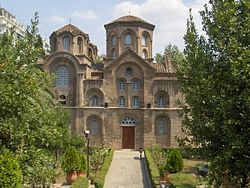
Within easy walking distance of our hotel was the Panagia Chalkeon Church. When we went inside, our eyes popped. Strewn on the floor, as if a carpet, were bay leaves. Hundreds and hundreds of bay leaves that rustled beneath our feet, each crunch releasing more of its fragrant aroma. The bay leaves came from gnarled trees outside the church, to the left, that were said to be from the time of St. Paul's ministry. Scholars say he wrote his first letter to the Apostles from Thessaloniki.

I'll never forget the red Easter eggs, Orthodoxy's symbol of the blood of Christ and the re-birth, in a simple bowl in an old church with bay leaves on the floor.


Friday, March 22, 2013

Tick Tock; Tick Tock

My grandmother kept her Longines wristwatch in its original box in her top dresser drawer. When we kids saw the watch on her slim wrist, we figured she was either going to the doctor or to visit a certain cousin. She complained doctors didn't see patients when they said they would and this cousin ran at the mouth so much she was going to talk her way out of heaven. Although I don't know about the heaven part, my grandmother was right about the chatty cousin and doctors who overbooked patients (even Back Then).

My mother kept the Longines wristwatch she rarely wore in a glass case on top of her dresser. We kids knew not to touch it, that something awful would happen--perhaps our hands would fall off or some such. Since my mother didn't raise her voice or threaten dire consequences, just said 'Don't touch,' I never quite figured out how it worked that we didn't touch her watch. But we didn't.

My grandmother called her Longines with the diamond chips around the crystal a wristwatch. My mother called her Longeines with slightly bigger diamonds a watch. We kids picked up on the generational nuance and knew when to use each word, not that we did so very often.

None of us kids had a watch. There was little reason to monitor time. School ended when it did, and regardless of the homework, books usually closed at the same time each school night. We'd watched a bit of television, take our baths, and off we'd go to bed. Weekends opened up--Friday night football, water skiing, perhaps a trip to Baton Rouge or the house filled with family and friends (hopefully with kids our ages). But Sunday night meant back to the books to make sure the homework was just right before going to bed.

My grandfather wore his watch when he left the farm for various meetings and the like; my father wore his watch to work during the week but not on weekends. Their watches had big round faces and were the polar opposite of dainty. Neither man had a habit of constantly checking his watch.

I like watches and can't pass a display window without stopping. Not that I want to purchase these watches. There's just something about how jewelers decorate a basic timepiece that appeals. More on the intangible level, I admit to pushing the clock to accomplish goals, something I've given thought to lately.

Actually, a sepia-tone photograph of my grandparents I came across in a box (while looking for something else) triggered these thoughts. My grandparents are sitting on a bench in El Paso, Texas, very nicely dressed in the 1920s fashion of the day, but neither's wearing a watch.

My grandmother used to fuss at me when I got too busy. "What are you rushing to?" she'd ask with a chuckle.

I had no answer for her then and would have no answer now, except to say that this afternoon I heard a bird chirping its heart out and stepped outside to find this feathered Adele. One chirp led to another until I finally spotted a Cardinal at the very top of a still-bare oak tree. I don't know how long I listened to its serenade. I didn't have my watch on. But the memory is forever.