Kittie Howard


Tuesday, September 3, 2013

The Beaches of Normandy and the Invasion of Normandy: June 6, 1944

After we picked up our rental car in Caen, France, we explored Normandy for two weeks, driving about a thousand miles as we criss-crossed the province. We stayed in large towns like Bayeux and small seaside towns like Luc sur Mer, dipped down to Brittany to see Mont St. Michele, wound our way back through the countryside to Honfleur, not far from La Harve, then returned to Caen to turn in our rental car.

Without a doubt, Normandy has some of the most gorgeous scenery possible. The rolling terrain with broad vistas, apple orchards, dairy cows in quiet pastures, and golden hay fields are post cards forever in my mind's eye. Stone walls outlining roads leading into villages with stone buildings and narrow streets enchanted.


The food was amazing. We feasted on steamed mussels (moules) in a variety of sauces, had picnics with baguettes filled with fresh crab or one of the area's incredible cheeses, shopped for seasonal fruit (melons, especially) in markets, and sipped 17-year old cider in the evening that was a cross between a port and a champagne. For breakfast, we'd go to the local patisserie: chocolate croissants for hub and anything with apples for me -- and didn't gain an ounce as we walked, climbed and hiked until the muscles no longer ached and our tempo increased.


One kilo (2.2 pounds) of mussels per order, with a side bowl of frites. The mussels are tiny, very sweet, and plucked with the fingers. Ohhhh, yum!


The people of Normandy were even more amazing: friendly, kind-hearted, and compassionate -- really solid, down to earth people. And, yes, many spoke English, especially the younger ones (who study it in school and want to practice).

But our ultimate destination was Utah Beach, where my husband's uncle was during World War II. Code-named Operation Overlord, the Invasion of Normandy was the largest armada ever assembled: 1,213 warships; 4,126 transport vessels; 736 ancillary craft; 864 merchant vessels; 195,700 personnel. Purpose: to liberate German-occupied France and kick Hitler's butt to hell.

Major military units that participated in the Invasion of Normandy, June 6, 1944:

British 6th Armoured Division; British 6th Airborne Division;
British I Corps; British 3rd Infantry Division;
British 27th Armoured Brigade

Canadian 3rd Infantry Division;
Canadian 2nd Armoured Brigade
(Note: Because the Canada Act wasn't passed until 1982, there were Canadian units co-mingled with some British forces as Canada had a different standing within the Commonwealth at that time.)

U.S. V Corps; U.S. 1st Infantry Division;
U.S. 29th Infantry Division; U.S. VII Corps;
U.S. 4th Infantry Division; U.S. 101st Airborne Division;
U.S. 82nd Airborne Division

Casualties, June 6, 1944:

Germany: 240,000 killed or missing
Britain: 11,000 killed; 54,000 wounded/missing
Canada: 5,000 killed; 13,000 wounded/missing
United States: 29,000 killed; 106,000 wounded/missing
France: 12,000 civilians killed or missing
(Note: It's commonly agreed exact statistics aren't possible. This is an agreed upon estimate by the various countries. Also, after the initial invasion, soldiers and/or airmen from other countries participated in the liberation of Normandy. These include: Belgium, Greece, the Netherlands, Australia, New Zealand, Norway, and Denmark. There were many individual monuments (including one to 800 Danish troops) to heroic achievements throughout Normandy,  but there was no overall casualty list that I saw.)


Planning for D-Day had begun in 1943. The English Channel's erratic weather caused much concern, as did the asymmetrical tides. The English Channel is the only place in the world where there are four tides, one every six hours. But when it's low tide on the French coast, it's high tide on the English coast.  Also, there were only 10 days a month when the tides were suitable for an amphibious landing. Originally planned for June 5, 1944, General Dwight David Eisenhower, the Supreme Allied Commander, changed the landing to the following day because of projected weather conditions. On June 9th, the worst storm in 40 years hit the English Channel.


Sword Beach. D-Day is much too complicated for my simple blog, so I'll share a few things I learned from each beach. The tide affected all of the five beaches: Sword, Juno, Gold, Omaha, Utah. The tide above, at Sword Beach, will pull back to the yellow ball to the upper left of the black rock (center).


Same spot six hours later. The four yellow balls are under water. The fewest casualties, 127, occurred at Sword Beach. But the British had to slug their way toward the more fortified interior to take their objective, Caen, where William the Conqueror's massive fort controlled the high ground and town. There is a very large British cemetery in Caen.


Beyond the yellow ball were these metal monstrosities to snare boats. They were also hidden among the natural hedgerows that had to be navigated once one crossed the beach. The hedgerows will be highlighted more in an upcoming post.


Juno Beach. The Canadian objective was to provide a flank to the British at Sword Beach then capture a German airfield at Caen. Bunkers lined the terrain above all the beaches, part of Hitler's Atlantic Wall. This particular bunker at Juno Beach deceives because it's slanted. Since Juno Beach was the flattest beach, the angled bunker provided a wider killing range. Weapons could also rotate, thus enlarging the field. Juno Beach was also the second most heavily fortified beach.

Because of this canal that split part of the beach, my husband, the military man, spent considerable time at Juno Beach. (While in the military, he'd received a Navy League award for conducting 26 amphibious training exercise landings without incident so had a keen eye for beaches.) What this canal did was establish a brutal killing field. Hub was very reflective when we left as he'd been in combat and  understood why that cross stood exactly where it stood. There is a large Canadian cemetery south of Caen where those who died in the Invasion are buried.


Gold Beach. Arromaches is the town fronting a wide sweep of beach with this protruding rocking anchoring the far end. After the British established a beachhead, they headed towards Route 13 to reach Bayeux and cut off the road to Caen. Very crucially, the British installed a bridge that had taken a year to design and build in England. Called the Mulberry Bridge, a remaining part can be seen to the lower left. 
A better view thanks to Wikipedia. Parts of the bridge, called Mulberries, are in the water. The Allies had to get supplies ashore as quickly as possible in order to continue the attack. Historians say that these Mulberry bridges (more like heavy pontoons) and the cutting of German communication lines by the Free French Resistance prior to the Invasion were essential to Operation Overlord. Hub thinks the French Resistance hasn't been given enough credit for its participation in the War.

A slight diversion: When we left Normandy, we took the train to Paris from Caen and stayed at The Westin on the Right Bank. When we stepped outside in the morning, we were surprised to see this movie scene being filmed. That's an American tank from one of the museums. We were told the film involves free French Resistance fighters and American soldiers, all actors, of course. To the right are prisoners (actors) from France's Vichy government forces. Basically, the Vichy government didn't just capitulate to avoid being overrun by Hitler, it conspired with Hitler. The collaboration remains a shameful period in French history the people are still coming to grips with. The storefront behind the tank had a period 'drop' with some nasty anti-Jewish slogans.
A member of the film crew swung a 'smoke' canister after the tank sputtered to life. It was kinda bone-chilling to see the tank roll forward. We were told the name of the film is "Diplomat" and that Scarlett Johanssen is in it.
Omaha Beach. The objective of U.S. forces was to secure a beachhead and link up with British forces to the east at Gold Beach and U.S. forces to the west at Utah Beach. However, contrary to what planners had though, Omaha Beach, a 5-mile stretch, was the most heavily fortified. Difficulties with the tides caused many landing craft (Higgins boats) to miss their target and/or to offload troops too far out. Many drowned. Defended by the German 352nd Division, of the 12,000 soldiers, about 4,000 were teenagers, many conscripted from German-occupied countries such as the Baltics. (Conscripts were also at the other beaches. Of Hitler's generals, only Rommel believed the Allies could land at Normandy. His other generals, too steeped in World War I tactics, believed as Hitler did, that the landing would be at Calais. Hitler slept until 12:30 pm on D-Day. His advisors were afraid to awaken him with the news the Allies had invaded shortly after midnight. Although Rommel commanded the whole area, he couldn't move the Panzer divisions without Hitler's approval.)
One of the German bunkers above Omaha Beach. Although I took the same photo, this is from Wikipedia. My little camera couldn't handle the ever-changing skies as the clouds rolled in and out, depending upon the evolution of the tides. During our two weeks, we experienced only one really bright, sunny day.
View from inside one of the other bunkers.  By the end of June 6th, U.S. forces had secured two small areas, primarily by scaling the bluffs at Omaha Beach. They'd shoot hooks into the bluffs (Point du Hoc) and climb ladders. As Germans shot lead climbers, others moved up until those small areas had been secured. Because the interior wasn't as heavily fortified, once these footholds had been gained, forces could exploit the weakness in the German defense and secure more ground.
Reflecting pool at the American cemetery overlooking Omaha Beach.
Over 9,000 markers, including 169 Stars of David. Seemingly endless and very, very reflective -- as are all of the Allied cemeteries -- and also very sad -- so young -- so brave -- but Hitler's boil had to be lanced -- and no one country could stop him -- I'm truly grateful to those who gave so much -- 

Utah Beach. Despite being somewhat off course, this landing went well and suffered the second fewest casualties (200). By the end of the day, over 25,000 soldiers and equipment were ashore. On July 16th, my husband's uncle Frank, who had been in training in England, landed here with other reinforcements, with his unit going with Patton's Third Army and the eventual Battle of the Bulge, which he survived. (However, Normandy wasn't considered secured until August 24th, so tough fighting remained.) During an earlier training exercise off the coast of England prior to D-Day, a German U-boat had torpedoed one of the landing craft, and 638 Americans had died. Still, Hitler didn't believe a landing was possible at Normandy.
A thatched cottage in Normandy. Home is where the heart is, wherever we live. But, by June 6,1944, Hitler's concentration camps had consumed close to 12 million people: six million Jews and almost six million Gypsies, Catholics, those with various handicaps and others not deemed worthy of the blond-haired, blue-eyed Master Race and Thousand Year Reich that Hitler envisioned. Hitler was neither blond-haired nor blue-eyed. Many historians think he was part Jewish. Still, his rhetoric prevailed.

To be continued . . . the aerial bombardment, parachutists and gliders . . . 


Saturday, July 20, 2013

Welcome to Lido di Jesolo, Italy


Time stopped in Lido de Jesolo! Our clock became the moon over the Adriatic Sea. Three evenings ago, my husband said, "The moon's a little bigger tonight." We both knew a day had passed, but neither asked the other which day. Now we're both aware we're leaving a week from Sunday. Now, when we say good-bye to other tourists after breakfast, we know our day grows closer. Even though we're going on to France from here, we're going to be sad about leaving Jesolo. We always are. We haven't found another holiday spot situated between the beach/pool and a tree-lined town that's completely pedestrian in the evening. Shaded sun for hub and walks in the shade during the day for me. I'd like to share some photos from my morning's walk.

The Ambasciatori Palace hotel provides free bikes, for the whole day if one desires, a good thing. The bikes are retro, just brakes, no gears. Since the land is flat, everyone just peddles along. It's nice, very nice. In the evening, the main street above will be pedestrian only. People will fill the street, just walking and talking and eating ice cream . . . or stopping for a coffee or glass of wine or bottle of cold water at one of the many coffee bars or eateries.

One of the menus. The price is in euros. One euro is about $1.30. The price you see includes tax and tip.
Something for everyone - water, Prosecco, wine

Display in one of the clothing shops. Marilyn Monroe remains eternal.

One of the many pizzerias/restaurants. The crust is very thin, with just enough sauce to cover, fresh toppings you order, and a little cheese. Unlike Pizza Hut, which uses melted lard to first coat the crust, they only use extra virgin olive oil here. Apartments are above the restaurant.

The United States is a Fair Trade Partner . . .


. . . so our products are popularly sold here . . .

. . . but like everywhere else, cheap Chinese goods are a problem. These are 2 euro copies of  hand-blown Murano glass pendants that would sell for between 10 and 20 euros. Collected together, these don't look half-bad. But they don't catch the light and look really cheap when worn. On Murano, the island near Venice famous for its glass factories, the pendants are displayed hanging in windows so one can see how the light infuses the pendant. They're absolutely gorgeous. So that's why the copies are in boxes . . . and clipped to the box at the back so it's too complicated for the tourist to hold up.

Like for authentic Murano glass, there are Made in Italy signs for leather goods.


Hub loves this 'salad of the sea' -- but see those black balls that look like olives? Umm, they're not olives; they're snails, a special type of snail. And they're alive. And they crawl around in the bowl. So, okay, one can't like everything everywhere, so, umm, I'm taking my usual pass here.

An Italian take on the British saying, "Keep Calm and Carry on." This is my favorite photo from our morning's walk. Thanks for coming with me. It was lots of fun. Until later, lots of hugs, K.

Thursday, June 27, 2013

Off to Italy; Blog on Mini Hiatus


Italy beckons -- the day that seemed a million years away is tomorrow -- wheee!

We'll fly to Vienna, Austria, spend the night at the NH Hotel (exit airport, cross street, go to room, crash), then catch an early a.m. flight to Venice (taxi to the Ambasciatori Palace hotel in Lido de Jesolo, go to room, change clothes, go to pool, start reading under shade tree, and zzzzzz and read and . . .).

Along the way, I hope to get caught up in Blogville and with my WIP as I've fallen woefully behind in this crazy month June's been.


Venice -- I liked how the bird perched on the post and enjoyed the breezes.

The nearby island of Burano and my favorite ferry stop. We go early, get a coffee at an outdoor place by one of the canals and watch the island come alive.

I walked around after our coffee to take some pics. A bicycle always pulls me closer. Burano is laid-back, not as commercialized as Venice. 
I can't resist these caloric bombs! Ohhhhh, pure bliss! Not too sweet with a hint of almond. *sighs*


The chocolate-creme torte hub surprised me with on my birthday last year! Very light, not too sweet *sighs again*


The beach/Adriatic Sea view from our room. We've had the same room the past six years. The shadows in the foreground are the trees by the pool. The heart shape in the sky is from an air show by Italy's air force. The horizon's grey cross the sea is Croatia. A few years ago we drove around the land hook and explored Croatia. Gorgeous scenery but few hotels and absolutely brutal prices for everything as their tourist market caters more to the enormous yachts that drop anchor.

Hub's favorite . . . no canned mushrooms and fake cheese . . .
. . . right around the corner . . .  on Sunday morning this area's more like Hangover Corner. Every Saturday night there's a huge beach party that draws kids from as far away as Milan -- very rich kids with incredibly expensive cars, parked wherever they can find a spot, convertible tops down (people admire but don't touch cars that are more like works of art) -- anyway, the party's loud (we bring ear plugs) and goes into the wee hours. Italians harness rather than fight rites of passage. When these kids learn to control their wild horses, they'll tolerate the same parties they're recovering from. And, counter image, Italy's got some really tough laws, as does all of the European Union, actually. No one even thinks of taking a sip of wine and driving, nononono!

Tiles by the pool . . . this is more our speed.
Happy Summer, Everyone!


Wednesday, June 12, 2013

Vanity Fair and Mary McCarthy's "The Group": Advice for Writers

Vanity Fair, Food & Wine, and Architectural Digest are my magazine treats, when I flop on the sofa and get lost in their pages. "Vassar Unzipped" by Laura Jacobs in the July issue of Vanity Fair, however, had an interesting point I thought would also catch your eye.

Jacobs does a great job of fleshing out backdrop stories surrounding Mary McCarthy's "The Group," her 1933 book about eight Vassar girls that was on The New York Times best seller list for almost three years. And, in the process, Mary McCarthy revolutionized much for female writers.

As Jacobs summarizes her article about McCarthy's career, she writes, "Novelists lift material from life because they must. First novels are invariably autobiographical, which is why second novels are so difficult: the writer needs to recede and let the characters create themselves. McCarthy never learned to back off and loosen her grip." (page 119)

Can you relate to what Jacobs wrote? I know I can. My first novella became more autobiographical than I thought it would. My second novella gave me fits until I instinctively realized I had to let a couple of characters do what they wanted to do. But, if I'd known to back off going into the second novella, I could've saved myself a lot of time and frustration.


Tuesday, April 16, 2013

A Little Box in Zanzibar

When the Kenyan Airways flight from Nairobi, Kenya, landed in Dar es Salam, the capital of Tanzania, I didn't know what to expect. Those few I knew who had visited Dar had described the city as 'sleepy' and then turned to talking about how they'd climbed Mount Kilimanjaro, Tanazania's famed mountain and exotic attraction in the late 1980s tourists knew about but hadn't yet conquered. Nor had tourists swarmed to the Serengeti for photo safaris. Roads leading outside Dar turned into unpaved challenges.

So this trip focused on Zanzibar, the coastal 'spice' island where so many of David Livingston's 19th century explorations had begun and ended.

As warned, Dar turned out to be sleepy. Buildings were mostly baroque and representative of the country's colonial past or cinder-block utilitarian and representative of the Soviet Union's influence. Unlike Nairobi, few cars traversed the downtown's paved streets, and even fewer people were on sidewalks. Those who did were solemn-faced. Shopkeepers waited behind window displays with scant merchandise. Like many countries in Africa during this period, Tanzania struggled to establish a foothold, both politically and economically.

With a sense of relief, we boarded the hydrofoil for Zanzibar, the only passengers on this sleek new vessel. Once we'd cleared the mainland, a young lady emerged from the pilot's cabin and joined us. She and her husband, the pilot, were from South Africa and had gambled their futures Zanzibar would turn into a tourist destination their hydrofoil could service.

As it turned out, they were right. Dar es Salaam now bustles with activity and shines from travel magazines. Zanzibar has an international airport, an international film festival, and tucked-away resorts high-end tourists seek. Whenever I see an advertisement for either, I sometimes wonder if that couple survived the lean, in-between years. I hope so.

In the meantime, the Indian Ocean's fresh air rejuvenated spirits, and we enjoyed the ride. After docking, we wished the young couple well and made our way to a quaint house not far from Stone Town, the former capital of the Zanzibar Sultanate, where we'd secured reservations before leaving Nairobi.

But, as it turned out again, we were the only guests. With scant running water in the un-airconditioned room, we patted water on our faces, set up the mosquito net, then shut the windows. We'd have to return from Stone Town before the mosquitoes found a way in through the loose frame (and, to our surprise, would swarm the white netting until it practically turned black).

As we neared Stone Town, our eyes widened. It was as though we walked into National Geographic, as close to a surreal experience I've ever experienced. Not only was it the visual experience of children playing in the town's dusty square near the historic Old Fort or vendors selling corn roasting on portable stoves or vegetables for sale or women gossiping beneath gnarled trees -- much of this existed elsewhere in Africa as well.

No, it was a combination of all of this and the Indian Ocean dotted with dhows -- and, more -- it was the scent of cloves. . . everywhere . . . on people's skin and clothes like the finest perfume . . . dancing on every ocean breeze . . . resting in narrow passageways . . . everywhere.

We bought ears of roasted corn and sat beneath one of the trees -- very happy we were the only tourists -- and munched our corn. A middle-aged woman approached us. In her hands she held a box that was about four inches by six inches.

She had made the box entirely of cloves. When I opened the lid, it was as though every holiday treat ever baked wrapped around my senses and brightened every smile ever smiled.

She wanted to sell me the box. When I asked how much, she replied, "One thousand dollars."

Two other women joined us, each with boxes. Some good-natured bargaining followed. The price changed to $100,000.

Ahem, that's a lot of money.

Convinced they'd met me half-way, the ladies were disappointed when I didn't buy one of their boxes.

I was, too.

But through the years, the memory of how a simple spice floated on breezes has made me think upon occasion . . . as it did after the massacre in New Town . . . as it did after the bomb explosions in Boston . . . for there was a time when a certain innocence prevailed . . . when a day began without tears for a loved one or friend or a stranger's heavy heavy heart didn't slow steps . . . and the thought of what-might-be wasn't held prisoner by what-had-been . . . so, as if reading my thoughts, my husband, a marathoner and tri-athlete who ran Boston some years ago, asked, "What if go to Boston next year to watch the Marathon?"

"Sure," I said. "I'm in."

And we returned to the television and the horrific events in Boston. . . it's all so sad, so very sad . . . but a sense of resolution and support propels one forward.


(Note: This in the second in a series of Things That Happened Along the Way.)


Approaching Zanzibar by air.  (Wikipedia)


Stone Town (Wikipedia)


Friday, April 5, 2013

A Taste of Greece

I love Greek food, and, to be happily honest, it loves me.

Three years ago, hub and I rode the ferry from Venice, Italy, to Patras, Greece, picked up our rental car and embarked upon one of our greatest trips ever: three weeks of exploring Greece, the birthplace of Western civilization . . .
Parthenon (Wikipedia)

 and the home of some of the most delicious food in the world. . .

including Dolmadakia Yialandji--also called Dolmades--Stuffed Grape Leaves--and one of my absolute favorites. You can stuff the grape leaves with just about anything, but, for me, the simpler, the better--just a few seasonings with the rice mixture--and there's sheer bliss! (theshiksa.com)
And, so, I'm sharing with you Martha's recipe (with her permission). Martha's a Greek-American lady I met some years ago at a Christmas function. One taste of her Dolmades and I knew Santa Claus was for real. Oh, yum! Her recipe is very simple, but it works. Instead of being overstuffed with too many competing flavors, these Dolmades are bursting with flavor. And, I didn't have to adjust the salt much (always a personal choice).

Surprisingly, Dolmades aren't difficult to make and easily feed a crowd. After Martha's recipe, there's a YouTube clip that shows how to roll the leaves and then gives a lemon sauce recipe for dipping, if desired. The chef in the video has a different recipe than Martha's for more ideas. You can be really creative. When we lived in Egypt, a neighbor added chopped garlic not only to the rice mixture but put a few cloves of garlic among the layers, along with a few slices of lemon. Other variations exist among the Mediterranean countries and elsewhere.


Martha's Grape Leaves Stuffed with Rice (Dolmadakia Yialandji)

4 medium onions, finely chopped
1 teaspoon salt
2/3 cup raw rice (short grain)
3/4 cup olive oil
l tablespoon fresh dill, chopped
l/2 cup parsley, chopped (reserve stalks)
3 bunches scallions, including green tops, chopped
1 small grated carrot (optional)
salt and pepper
juice of one lemon
12-ounce jar grapevine leaves (found in most specialty stores and larger supermarkets)
l cup boiling water

Prior to combining ingredients, soak and drain grapevine leaves several times to remove the brine; if you have fresh grapevine leaves, wash carefully.

Steam onions over very low heat with 1 teaspoon salt, stirring occasionally for 5-10 minutes. Remove from heat. Add rice and l/2 cup of olive oil and mix. Add herbs and mix. Add salt and pepper and half the lemon juice.

Separate grapevine leaves carefully. Snip stems. Place 1 tablespoon filling on underside of leaf. Starting at the base, fold over, and fold in sides, rolling tightly toward point. (Note: the video starts with the sides; I think Martha's way gives a tighter roll as these leaves do expand.)

Place reserve stalks and any torn leaves on bottom of pan. Arrange Dolmandakia in layers with seamed side down. Add the remaining lemon juice and  3/4 cup olive oil. Place a plate on top of dolmadakia to prevent them from unrolling.

Cover sauce pan and simmer for 20 minutes over low heat. Add l cup boiling water and simmer for 25 minutes longer. (Note: Video calls for baking leaves. Have never done this so don't know.)

Transfer to platter. Drizzle with olive oil and lemon juice, if desired.

The YouTube clip is HERE.

Enjoy!


Thursday, March 28, 2013

Easter in Thessaloniki, Greece


As Easter approaches, I'm entertaining nice thoughts about past holidays:  the smiles . . . a little something that stuck in the mind's eye -- a panoply of tulips near the front steps to my mother's house and when I opened the door the aroma of good things cooking in the kitchen flooded my senses. Yes, that's what happy memories do. They flood the senses and wrap the soul in warm fuzzies.

Such is the feeling now. Even though it's cold outside and spring's a no-show, I feel warmed and blessed by so much. So many good things. From the Hallmark angel my niece gave me to family trips and gatherings to an Easter in another country that was also very, very nice.

Thessaloniki, Greece.

In 2004, my husband and I spent Easter in Thessaloniki. It's a traveler's story for a lazy afternoon as to how this came to be, but, suffice it to say, we were delighted it did. Even if we aren't Greek Orthodox and even if Easter's dates float among the Christian faiths, it didn't matter. Oh, but life's roller coaster can take some magical turns. I'd like to share one of those turns. Come on. Don't be shy. Put on your virtual Nike's. We've got some hoofing to do before we get to what infused the senses . . .

With about a million residents, Thessaloniki sprawls from the Aegean Sea to the mountains. (Mount Olympus is in the background.) Alongside the sea is a corniche where one can walk and browse shops, stop at one of the many outdoor coffee shops or restaurants or get an ice cream cone and just walk and walk. (Wikipedia)

The port is huge, one of the largest in Europe.  (Wikipedia)

Our hotel was in Aristotelous Square (formerly known as Alexander the Great Square), in the hotel to the left. (Wikipedia) Prior to Easter, people packed the square, in a hurry to complete pre-Easter errands. Others fortified themselves with cups of coffee or something to eat in coffee houses and seafood restaurants on either side of the Square prior to entering the melee.

Not far from the Square were more coffee houses and restaurants along the corniche. In one direction, the corniche led to the White Tower . . . 
The White Tower is the city's signature landmark. It is one of 15 UNESCO World Heritage sites in Thessaloniki, also considered Greece's cultural center by many. Love that corniche! (Wikipedia)

A cup of coffee and an ice cream later and we circle back. This ruin (forum and baths) isn't far from the city center and was discovered by accident in the 1960s. Whether in Thessaloniki or elsewhere, it seems like everywhere one goes in Greece there are the most fantastic archeological treasures.


Also nearby: the Old City (Ano Polis) and narrow, cobblestone streets and tucked away shops. The Old City was a beehive of pre-holiday activity, especially the flower market. oh but the arrangements and bouquets were amazing. Floral scents and the aroma of fresh-brewed coffee and the displays in confectioners' windows stirred the senses beyond words. (Wikipedia) 

But regardless of where we went, from the moment we stepped into our hotel lobby, Red Easter Eggs were on counters in every shop everywhere one went. No one I saw took an egg, but everyone was careful not to bump the bowl of eggs at the counter. It was amazing to stop for coffee and see the bowl of red eggs or go into shop after shop and there they were, magnificent, absolutely glorious in their simplicity. I would later spend another Easter in a Christian Orthodox country with the same custom of displaying red eggs, but this display wasn't on the magnitude found in Thessaloniki. I later learned that Greece is known for its Easter celebrations, and many Greek-Americans trek to Greece in order to be there for the holiest day on the Orthodox calendar. (Note: Commercial dyes exist to color the eggs, but many prefer to boil the eggs in a bit of vinegar added to water that includes the skins of yellow (Spanish) onions.) (Food Network)


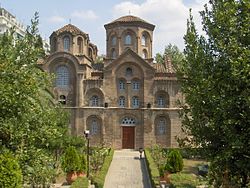
Within easy walking distance of our hotel was the Panagia Chalkeon Church. When we went inside, our eyes popped. Strewn on the floor, as if a carpet, were bay leaves. Hundreds and hundreds of bay leaves that rustled beneath our feet, each crunch releasing more of its fragrant aroma. The bay leaves came from gnarled trees outside the church, to the left, that were said to be from the time of St. Paul's ministry. Scholars say he wrote his first letter to the Apostles from Thessaloniki.

I'll never forget the red Easter eggs, Orthodoxy's symbol of the blood of Christ and the re-birth, in a simple bowl in an old church with bay leaves on the floor.